Collect
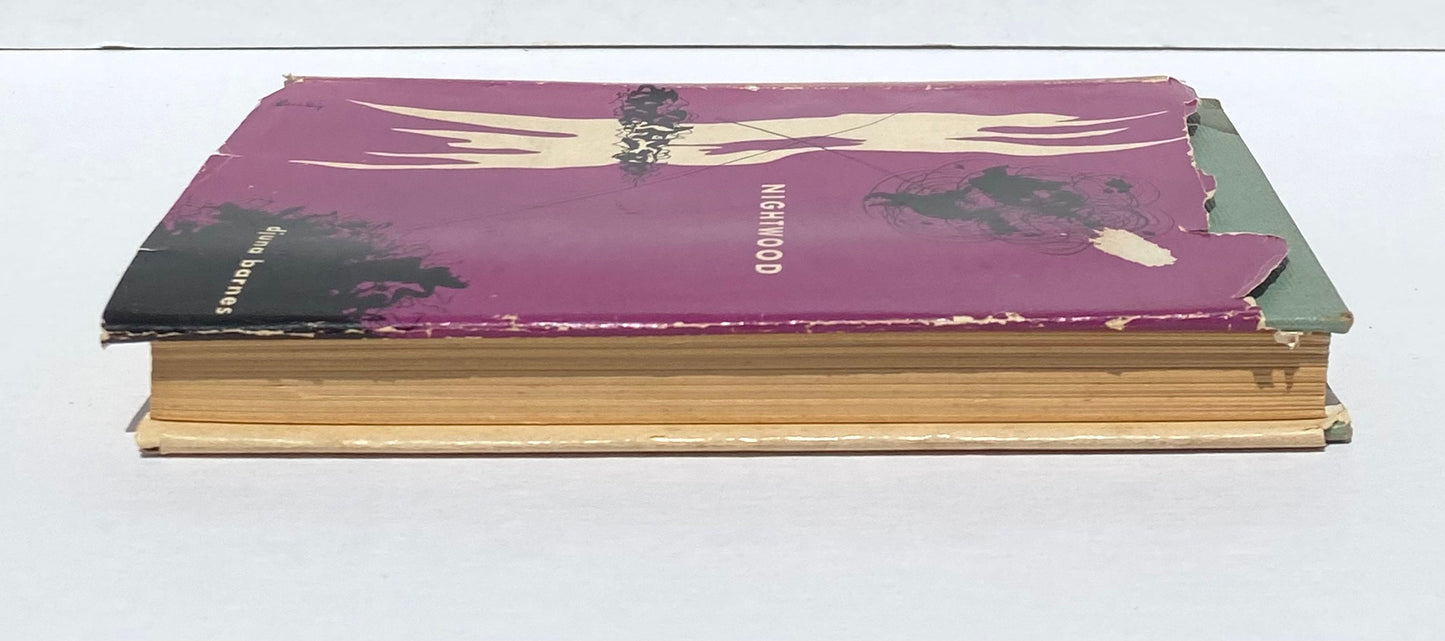
Vintage Nightwood by Djuna Barnes with and intro by T.S. Elliot
Vintage Nightwood by Djuna Barnes with and intro by T.S. Elliot
Couldn't load pickup availability
Vintage Nightwood by Djuna Barnes with and intro by T.S. Elliot
Nightwood is a 1936 novel and is one of the early prominent novels to portray explicit homosexuality between women, and as such can be considered lesbian literature.
It is also notable for its intense, gothic prose style. The novel employs modernist techniques such as its unusual form or narrative and can be considered metafiction, It was praised by other modernist authors including T. S. Eliot, who edited the novel, helped publish it, and wrote an introduction included in the 1937 edition published by Harcourt, Brace. As a roman à clef, the novel features a thinly veiled portrait of Barnes in the character of Nora Flood, whereas Nora's lover Robin Vote is a composite of Thelma Wood and the Baroness Elsa von Freytag-Loringhoven, Jenny Petherbridge is Henriette Alice McCrea-Metcalf, and Felix Volkbein is derived from Frederick Philip Grove.
Djuna Barnes was active as a journalist and fiction writer during a period of immense sociocultural change and upheaval. In the years after World War I, millions of young people found themselves struggling to make sense of the world after such unprecedented violence and bloodshed changed the European landscape. At the same time, women’s movements all over the Western world were taking place as women protested for the right to vote and other feminist issues (notably for prohibition in America and wage equality in England). Barnes herself was an active advocate for women’s rights, particularly in support of reproductive rights and for the elimination of double standards that condemn women for sexual behavior that men are free to engage in. During the 1920s, Barnes was one of many writers who settled in Paris to enjoy the bohemian atmosphere and company of some of the biggest names in literature. This atmosphere and the general excitement people felt at the end of World War I led to greater social tolerance of certain groups, including the LGBTQ population. During Barnes’s time in Paris, there were a number of salons set up by lesbians where novelists, poets, artists, and musicians (of any gender) would congregate to chat and network. One of the most popular was Gertrude Stein’s salon on the Rue de Fleurus, and Barnes herself spent a lot of time at Natalie Barney’s salon on the Rue Jacob. This had a huge influence on Barnes’s writing and she based many of her characters on the people she met at Barney’s salon.
About the author:
Djuna Barnes was born in a log cabin in New York State on June 12, 1892. She was the second child of Wald and Elizabeth Barnes. Wald Barnes believed in polygamy, and so he brought his mistress, Fanny Clark, to live with the family. Wald was a failed composer and artist, so his mother, Zadel Barnes, kept the growing family financially afloat. When Djuna Barnes was 18, her father and grandmother pressured her into marrying Fanny Clark’s brother, Percy Faulkner, who was 52 at the time. The marriage was extremely short-lived (it lasted no more than two months by many accounts) and Barnes moved to New York City with her mother and three brothers in 1912, after Wald and Elizabeth divorced. Barnes briefly studied art at the Pratt Institute and the Art Students League of New York, but eventually took a job as a reporter for the Brooklyn Daily Eagle. Barnes quickly gained a following for her unusual articles and willingness to go into traditionally male spaces for a story (such as diving into the world of boxing). In 1921, Barnes went to Paris on an assignment and made it her home for the next few years. Barnes was a fixture on the Left Bank, which was also home to notable writers like Gertrude Stein and Ernest Hemingway. While there, Barnes met Thelma Wood (a sculptor from Kansas) and by 1922 the two were in love and living together in Paris. Barnes continued writing articles for newspapers until 1928, when she began writing novels. Her first novel, Ryder, proved a success when it was published in 1928. That same year, Barnes and Wood broke up. Over the next few years, Barnes moved around, eventually moving into Peggy Guggenheim’s English manor. This is where she wrote the semi-autobiographical Nightwood. Barnes also developed a drinking habit that culminated in a suicide attempt in 1939. Guggenheim sent Barnes back to Barnes’ mother in New York, and her mother sent Barnes to a sanatorium to get sober. Barnes then moved into her own apartment in Greenwich Village where she struggled to earn a living. Barnes wrote The Antiphon (a scathing criticism of her family thinly veiled as a tragedy in verse) in 1958 as well as a few poems, but she didn’t publish any more fiction after that. Barnes became a notorious recluse and rarely left her apartment until her death. She was voted into the National Institute of Arts and Letters in 1961 and given a senior fellowship in the National Endowment for the Arts in 1981. Barnes died in her apartment six days after her 90th birthday in 1982.
This book is from 1937. The original paper cover is rather torn (we have since taped the cover so as not to lose it). The cloth cover is still in good vintage condition. The pages of the novel are all legible and tightly bound.
Reach out with any questions!
Share